
With seemingly unlimited posibilities avaliable at your fingertips, at what point is it too much?
Finding someone from the comfort of your bedroom has never been easier, yet many users have grown disillusioned by online dating apps like Tinder, Bumble, and Hinge. Photo by cottonbro studio from Pexels.
By Nacelyn Almodóvar | August 3, 2026
Many couples today have met through dating apps, but online dating culture is often characterized by endless swipes, limitless options, and conversations that lead nowhere, even after a promising first date. The abundance of choices can make genuine connections harder to trust, and this leaves many singles wondering whether they’re being chosen or if they’re in a constant cycle of rejection and comparison. Swiping out of habit instead of curiosity, the same conversation yet again, and practices like ghosting can leave a feeling of emotional burnout or fatigue on those who use dating apps.
According to a 2025 Forbes Health/One Poll survey 78% of dating app users reported experiencing dating burnout. The findings suggest that burnout is becoming a common part of the online dating experience rather than an isolated problem.
The survey found that some common causes that contribute to dating app burnout include difficulty finding meaningful connections, ghosting, catfishing, disappointment and rejection, repetitive conversations, and swiping fatigue. Other experiences that can contribute are love bombing, abusive behavior, cheating, racism, sexism, and gaslighting.
Along with an abundance of potential matches available, there is ambiguity associated with many individuals’ dating intentions. The survey determined that nearly half of all users are seeking a long-term relationship, with 52% of Generation Z and 49% of Millennials seeking one. However, about 20% of users are more interested in engaging in casual encounters and 9% are interested in friendships.
What dating burnout feels like
Studies show that, over time, some users grow tired of using dating apps to find a partner, and that can be attributed to burnout. Photo by cottonbro studio from Pexels.
The researchers of “Burnt out and still single: Susceptibility to dating app burnout over time” defined dating app burnout as “chronic stress accompanying the use of dating apps”. Their emphasis on speed and ease of connection encourages users to consume the profiles of potential partners quickly. The study highlights that they combine elements of consumerism with the search for intimacy since they provide accessibility, constant availability, a large dating pool, and seemingly unlimited perfectly-curated profiles. Amid seemingly endless choices, it’s easy to feel depleted, lost, and dispensable to other people.
Psychologist and neurocoach Yessenia Rosado points out that some people tend to use the likes they receive as reference of their personal value instead of a compatibility mismatch.
Practices like ‘ghosting’ do not allow the person to close out the experience and can leave them feeling unilaterally blindsided. “Sometimes it has nothing to do with you, and it has to do with the other person. Maybe they were not ready, maybe they had left something unfinished and decided to pursue it again, and you were in the middle. There are many scenarios,” says Rosado. “The most important thing is to name and validate the experience.” she added.
Interaction through dating apps can have varying degrees of time investment. When feelings like shame appear, it’s common to think that you shouldn’t feel this way because the interaction took place during a short period of time. “It is not about the time. It’s about what it made you feel,” stated Rosado. “The person thinks ‘they stopped replying’, but they do not know the reason and this can leave an emptiness that is difficult to explain. They keep looking for a reason, and they tend to start blaming themselves because it gives them a feeling of control.” Rosado continued.
Thinking it was something that you did, or something you said, can be painful. Yet it can also create the illusion that if you identify what went wrong, you can prevent it from happening again. “You might be processing the grief of what you thought would happen, the version of them that you met, and the illusion that you found someone that was very compatible with you, the possibility of feeling chosen, and the trust you were starting to give to someone else.” Rosado describes.
There is no universal way people experience dating app burnout because every person’s history is different. Rosado urges those who experience burnout to take a step back and try to identify what is causing it. “Is it that you do not receive many likes, that you have conversations that lead nowhere, the ghosting or the lack of clarity, do you feel bad about your physical appearance?.” she lists.
Dating with intention
There is no one way solution to a dating app burnout, but there are ways that users can date with intention even when their dating goals are not to find a long-term relationship. Recovering from dating app burnout often involves changing the way you engage with the apps rather than abandoning them altogether. “The apps are not good or bad. They’re tools to amplify the possibilities of finding connection.” mentioned Rosado.
Being intentional can begin with having honest conversations with yourself about why you are using dating apps, what you’re looking for, and identifying when you need to take a break.
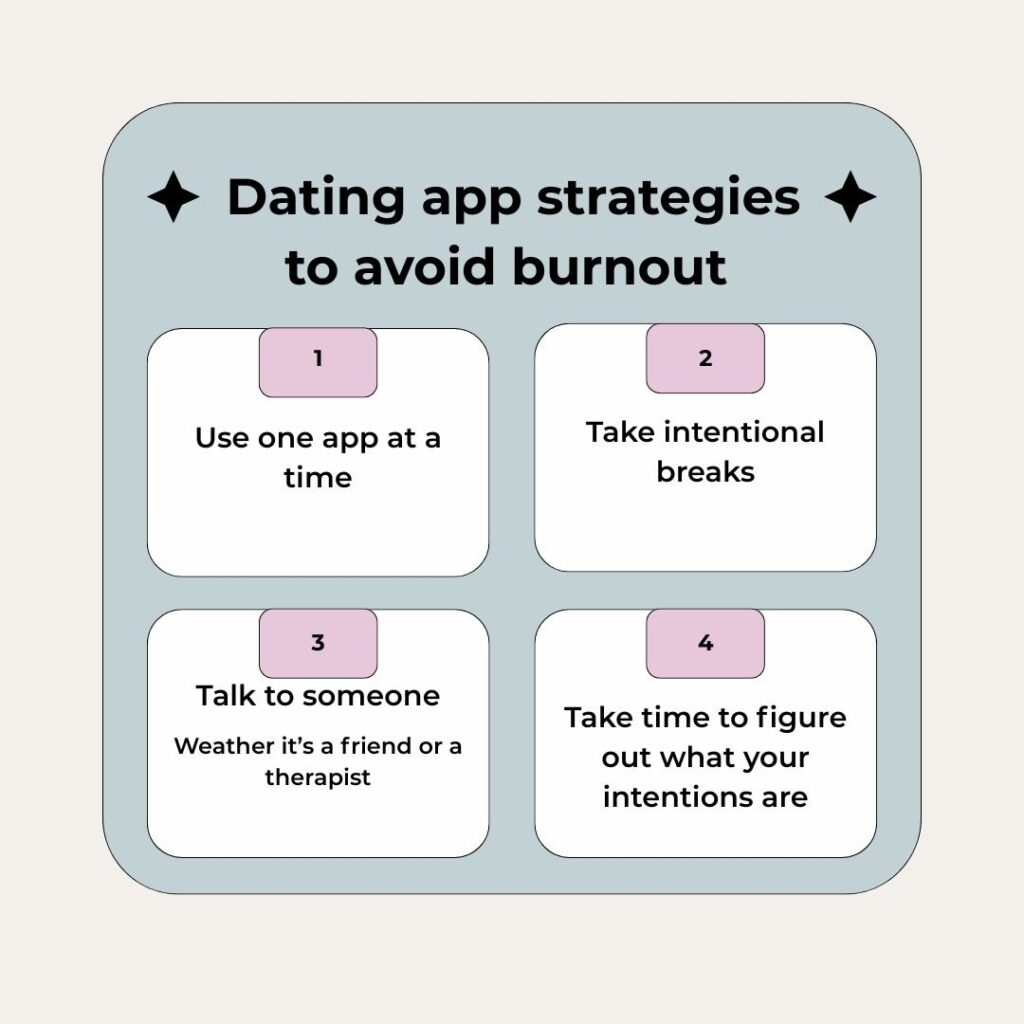
Infographic by Nacelyn Almodóvar.
The search for a romantic connection can be the beginning of a story and, as Rosado pointed out, two people can experience the same story in very different ways. When someone disappears without explanation, people often attempt to create their own ending and those are rarely kind to themselves. Rosado encourages people to resist filling in the blanks with self-criticism. Instead, she says, the other person’s behavior already communicated something important: they were not offering the clarity or reciprocity needed for a healthy connection.
The interview for this report was conducted in Spanish and translated into English.